Free Speech And Why It Matters by Andrew Doyle
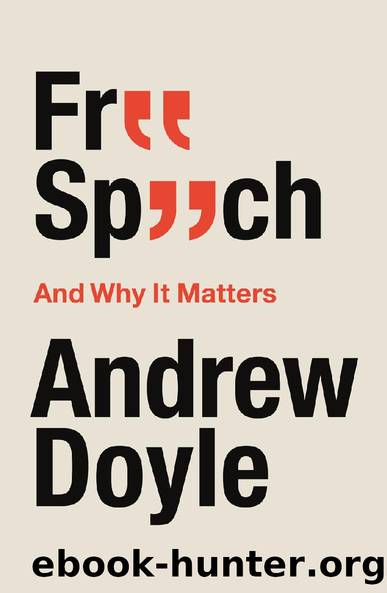
Author:Andrew Doyle [Doyle, Andrew]
Language: eng
Format: epub, azw3
Publisher: Little, Brown Book Group
Published: 2021-02-24T16:00:00+00:00
Identity Quakes
It is somewhat inevitable that language and, by extension, freedom of speech, should come to be mistrusted given that most of these recent developments are connected to the rise of an identity-orientated social justice ideology which is largely post-modernist in origin. In particular, contemporary activists have retained the postmodernist notion that reality, or at least our perception of it, is constructed predominantly through language. Michel Foucaultâs belief in the interconnectivity of power and knowledge is often seen as the basis for current discourses of the âpower structuresâ that dominate society. In this model, language is not only a means of communication, but a weapon of the powerful to maintain their hegemony. This is why those who support censorship often claim that unfettered speech has the effect of ânormalisingâ or âlegitimisingâ hateful and violent views. As I have outlined, this does not merely apply to insulting or offensive sentiments, but also transgressive opinions.
We have all felt that sensation of disquietude when our most cherished certainties are challenged. Tom Holland has noted how the palaeontologist Edward Drinker Cope, who was raised a Quaker and taught that the Bible was the literal truth, was âso unsettled by the dinosaurs he found entombed in rock that they came to visit him in his dreamsâ, where they would kick and trample upon him. A similar crisis of faith befell Charles Darwin, who could not reconcile the notion of a âbeneficent and omnipotent Godâ with the brutal reproductive practices of the ichneumon wasp, which paralyses caterpillars with its sting so that its larvae can develop inside a living host. Darwinâs Christian identity was shaken by the evident cruelty of the natural world.
Such realisations are known as âidentity quakesâ, described by Peter Boghossian and James Lindsay as the âemotional reaction that follows from having oneâs core values disruptedâ. For the open-minded, life is by necessity punctuated with these little shocks of awakening. Without introspection, there can be no individual development. We all remember Socratesâs famous dictum that the unexamined life is not worth living, and it seems to me that we deny ourselves the opportunity for growth when we refuse to interrogate our own certainties. It is intellectual suicide in slow motion.
Words are indubitably a potential source of great distress, whether that takes the form of a challenge to our worldview or outright abuse. Yet taking offence is a matter of choice. Marcus Aurelius said it this way: âChoose not to be harmed â and you wonât feel harmed. Donât feel harmed â and you havenât beenâ. Of course, we have every reason to suppose that the life of a Roman emperor might be more comfortable than ours but, in the interests of self-preservation, there is something to be said for the stoical ethos.
It comes down to a question of consent. If a man were to punch me, or otherwise inflict harm upon me by physical means, I am in no position to prevent the injury. There is no such loss of liberty in the taking
Download
Free Speech And Why It Matters by Andrew Doyle.azw3
This site does not store any files on its server. We only index and link to content provided by other sites. Please contact the content providers to delete copyright contents if any and email us, we'll remove relevant links or contents immediately.
| Anthropology | Archaeology |
| Philosophy | Politics & Government |
| Social Sciences | Sociology |
| Women's Studies |
Cecilia; Or, Memoirs of an Heiress — Volume 1 by Fanny Burney(32558)
The Great Music City by Andrea Baker(32018)
Cecilia; Or, Memoirs of an Heiress — Volume 2 by Fanny Burney(31956)
Cecilia; Or, Memoirs of an Heiress — Volume 3 by Fanny Burney(31941)
We're Going to Need More Wine by Gabrielle Union(19046)
All the Missing Girls by Megan Miranda(16023)
Pimp by Iceberg Slim(14506)
For the Love of Europe by Rick Steves(14121)
Bombshells: Glamour Girls of a Lifetime by Sullivan Steve(14073)
Talking to Strangers by Malcolm Gladwell(13370)
Norse Mythology by Gaiman Neil(13363)
Fifty Shades Freed by E L James(13239)
Mindhunter: Inside the FBI's Elite Serial Crime Unit by John E. Douglas & Mark Olshaker(9339)
Crazy Rich Asians by Kevin Kwan(9290)
The Lost Art of Listening by Michael P. Nichols(7506)
Enlightenment Now: The Case for Reason, Science, Humanism, and Progress by Steven Pinker(7311)
The Four Agreements by Don Miguel Ruiz(6765)
Bad Blood by John Carreyrou(6621)
Weapons of Math Destruction by Cathy O'Neil(6279)
